




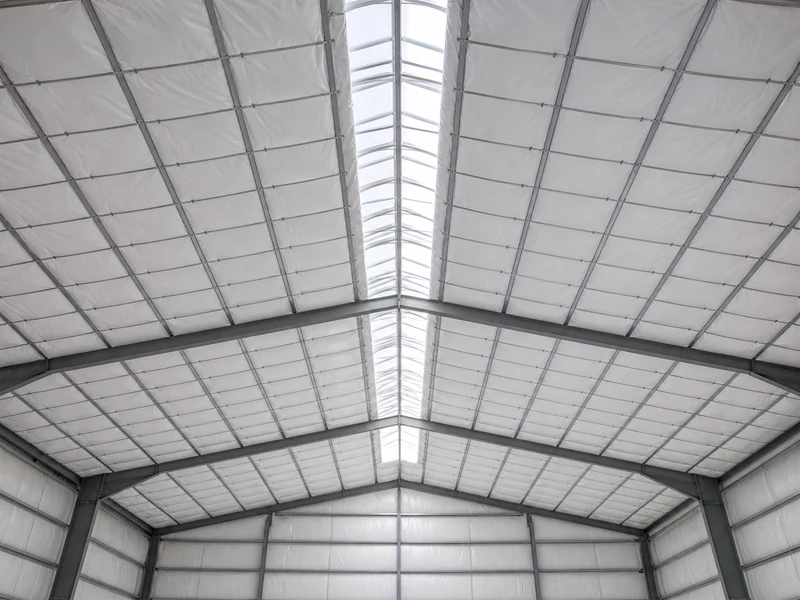
Metal building insulation only performs if it stays put, and the pieces that keep it in place are the fasteners and supports that band, pin, hang, or seal it against the steel frame. A few methods do most of this work: polypropylene or steel banding stretched across the blanket, stick pins glued to the panels, support hangers that suspend batts inside a cavity, and seam tape that closes the facing. They all reach the same two members, the purlins overhead and the girts on the walls, and they hold through self-drilling screws, adhesive bases, or bent prongs. Picking the right combination is part of any complete metal building insulation system. The choice decides whether the blanket keeps its shape and its rated R-value for decades, or sags and leaks within a few seasons.
What insulation fasteners do in a metal building system
Insulation fasteners hold blanket or batt insulation tight against the framing without crushing its facing or breaking the vapor seal. That is a different job from the structural screws that fix roof and wall panels to the steel. Panel fasteners carry wind and weather loads; insulation fasteners only have to keep a lightweight blanket from sagging and to keep the facing continuous. This article covers the second group, the retention and support hardware, not the panel-to-purlin screws. They also do not stand in for the engineered cladding, structural, or fall-protection fasteners the building was designed with, which are specified separately and to their own loads.
The reason the distinction matters is the vapor barrier. The facing on faced insulation doubles as the vapor retarder, so every spot where a fastener pierces it or a strap crosses it is a potential leak. These pieces are some of the smallest metal building components on the job, but a sloppy fastening pattern undoes the thermal envelope the insulation was bought to create. An insulation system is only as good as its weakest seam.
Main types of metal building insulation fasteners
Most metal building insulation is held by one of four things: banding, stick pins, support hangers, or seam tape. The right pick depends on whether you are working a roof or a wall, and new construction or a retrofit.
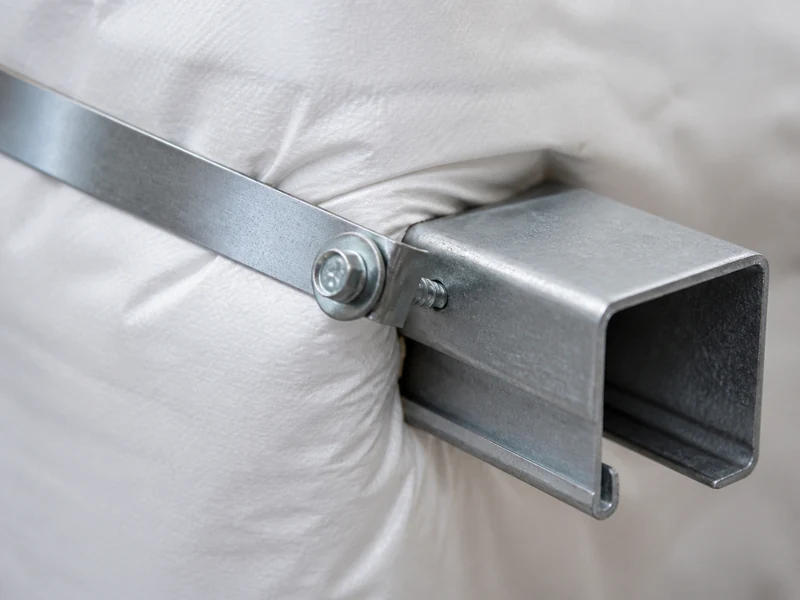
Banding and strapping
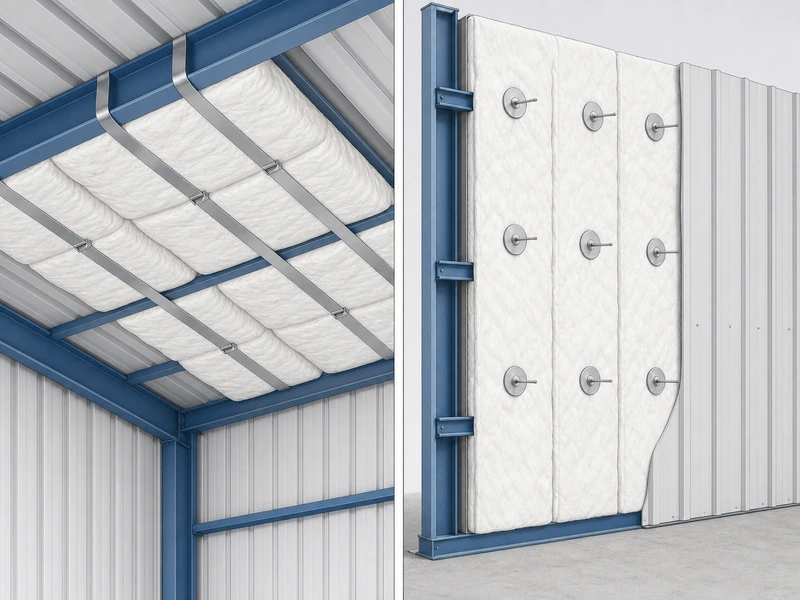
Banding is the workhorse for roofs and for high-R double-layer systems. Steel banding, typically around one inch wide, is screwed to the purlins on roughly a 30-inch grid with short hex-head self-drilling screws, forming a net that the blanket rests on. For blanket insulation in post-frame and pole-barn walls, installers often use polypropylene strapping instead, running a strap every few feet, at each purlin or every other one. The band runs perpendicular to the insulation rolls and compresses the profile slightly, holding the blanket flat against the steel rather than letting it belly down between supports.
Stick pins and washers
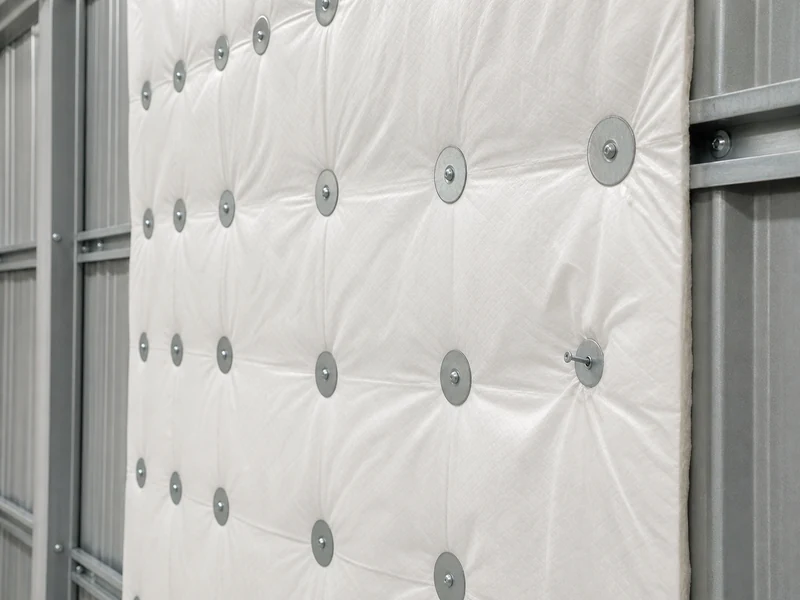
Stick pins handle walls and ceilings where threading banding would be awkward. A self-adhesive base sticks to the panel or a structural face, a spike pierces the insulation, and a washer slips over the spike to clamp the blanket before the tip is trimmed off. Spacing of about 16 inches is common, and the result is the quilted look you see on many shop and barn walls. In areas with foot traffic or stored goods, the cut spikes should be capped or folded so no one catches a hand on them.
Insulation support hangers
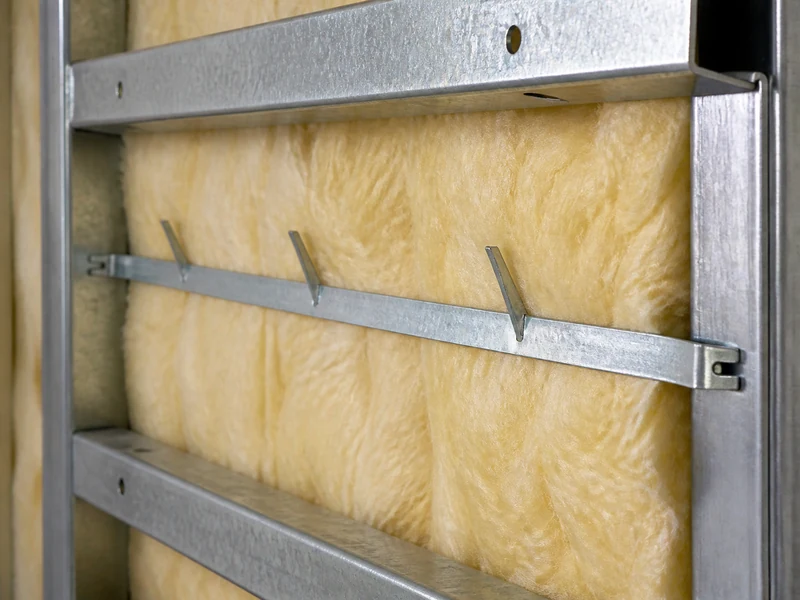
Support hangers suspend insulation inside a cavity so it fills the full depth and resists sagging over time. A galvanized support strip, commonly around 20-gauge and an inch wide, fastens to the framing, and bent prongs hold unfaced batts up between the girts. The strips ship in long rolls and get cut to length, often into 36- or 48-inch pieces, so spacing follows the cavity rather than a fixed rule. Hangers are a frequent choice for filled-cavity wall systems and for retrofits where insulation has started to droop.
Seam tape and sealing
Seam tape is not a fastener, but it finishes the job the fasteners start by closing the facing into a continuous vapor barrier. Use a foil-faced or acrylic tape made for insulation seams, not standard duct tape. Duct tape relies on a rubber adhesive that degrades under the temperature swings inside a metal building and tends to peel within a season or two, opening the seams it was meant to close. Where a strap crosses the facing, a strip of patch tape over the contact line keeps that junction from becoming a vapor leak.
How fasteners anchor to purlins and girts
Almost every insulation fastener ends at a purlin or a girt, the horizontal steel members that the screws, prongs, or adhesive ultimately rely on. Self-drilling screws, often called TEK screws, drill, tap, and set in a single pass into the C-section or Z-section steel, so no pilot hole is needed. As the insulation gets thicker, the screws get longer; deep double-layer roof assemblies can call for screws several inches long to reach solid steel through the blanket.
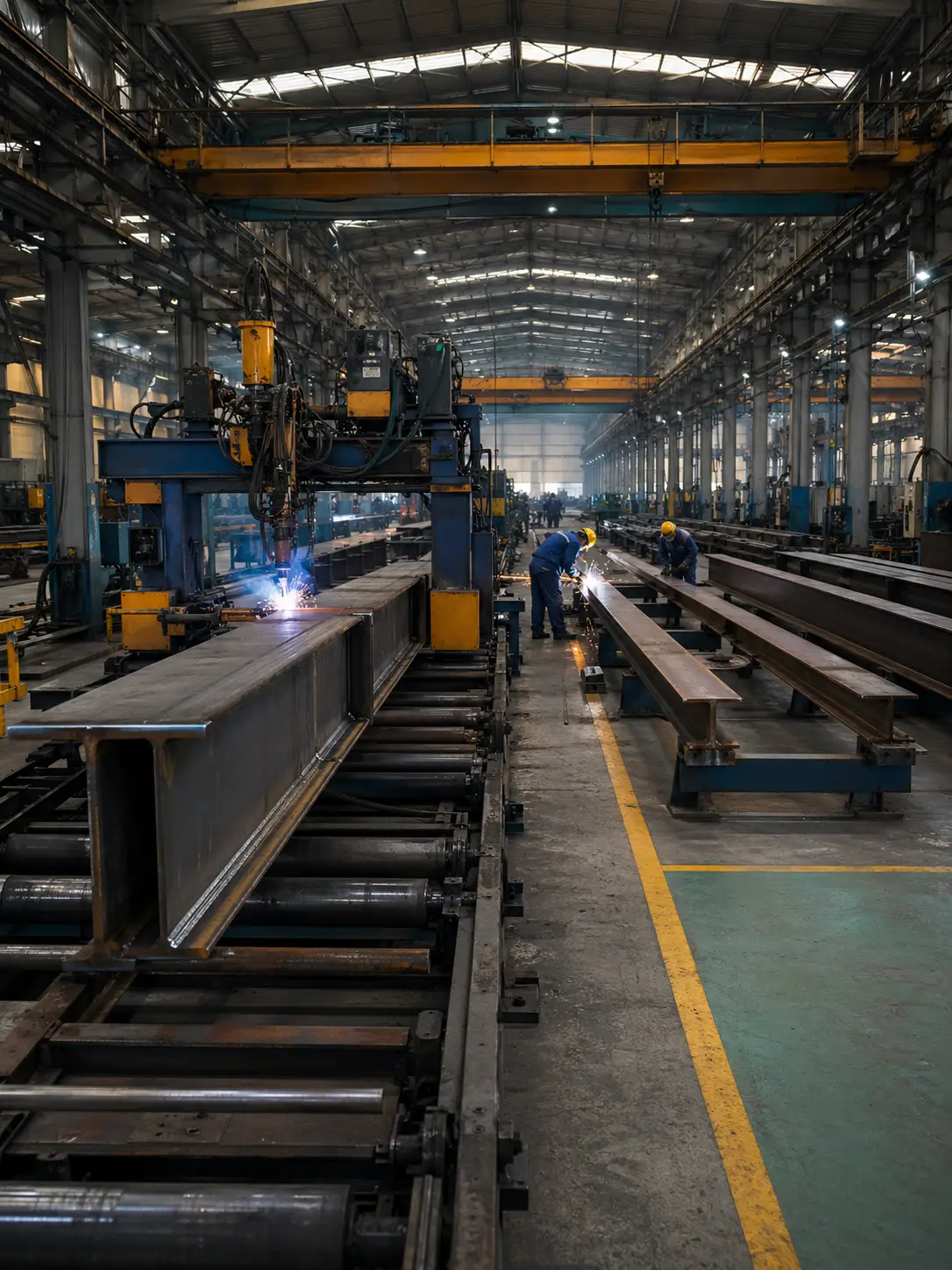
Driving force is where crews lose R-value without noticing. A banding screw should be tightened just enough to hold the strap firm, not cranked down until it dimples the profile, because the lost loft is lost insulation value at that line. The right screw length and band spacing are not universal; they follow the purlin and girt gauge, the insulation system (single or double layer, faced or unfaced), any interior liner panel, and whether a thermal block sits between the steel and the fastener line. Because KAFA fabricates its own C-section and Z-section purlins and girts, the gauge and spacing are known before the insulation crew arrives. That makes it straightforward to spec screw length and strap spacing to the actual frame instead of guessing on site.
Matching the fastener method to the job
The fastener method follows the application: roof or wall, single or double layer, and new build or retrofit, in roughly that order. Settle those three questions and the hardware mostly chooses itself.
| Application | Common method | Why it fits |
|---|---|---|
| Roof, single layer between purlins | Banding or laminated facing tabs | Holds the blanket up against the purlins and resists sag |
| Roof, double layer or high R | Steel banding grid with support strips | Carries the heavier laminated insulation and reaches higher R |
| Walls | Stick pins and washers, or support hangers | Keeps a clean interior face and fills the cavity |
| Retrofit over sagging insulation | Support hangers or added banding | Re-supports the blanket without pulling panels |
Sprayed systems are the exception to all of this. Spray foam insulation bonds directly to the panel and needs no mechanical fasteners at all, which is one reason some retrofits skip the hardware question entirely and others cannot. For the broader sequence that fastening fits into, from material choice to facing, see how to insulate a metal building end to end.
Where insulation fastening goes wrong
Insulation fastening fails in predictable ways, and crushed facing leads the list. Over-tightening a band or pin squeezes the blanket thin at every support, and each compressed line is a strip of reduced R-value running the length of the building. The fix is restraint on the driver, not a different fastener.
Unsealed seams are the next failure. A blanket can be perfectly supported and still leak if the strap-to-facing crossings and the facing overlaps are not taped, because warm interior air then carries moisture into the assembly. This is where the fastening system overlaps the metal building vapor barrier, and the two are best handled as one detail rather than split between trades.
Three more problems show up often enough to plan around. The wrong tape, covered above, opens seams within a year. Thermal bridging is unavoidable to a degree, since every metal screw conducts some heat from the warm side to the cold side. A sensible fastener count, plus stainless or coated screws at the worst spots, keeps that loss small. Corrosion is the one that shows up late. In coastal or high-humidity air, fastener corrosion and slow backout at the purlins is the first thing to check on an older building, and long-life coated or stainless screws hold far better than bare zinc-plated ones.
Conclusion
Lock the application before the hardware. Confirm roof versus wall, single versus double layer, and new versus retrofit, and the fastener choice mostly falls out of those answers. Banding and laminated tabs carry roof blankets, stick pins and hangers handle walls and cavities, and seam tape ties the facing into one vapor barrier. Whatever holds the insulation, drive it to grip the purlin or girt without crushing the loft, tape every strap-to-facing crossing, and match the screw coating to the building’s humidity. Get those three right and the insulation keeps the shape, and the R-value, you specified.
FAQ
What fasteners hold insulation in a metal building?
Banding, stick pins with washers, and support hangers hold the insulation, while seam tape closes the facing. Banding and laminated facing tabs are usual on roofs, where they support the blanket against the purlins; stick pins and support hangers are more common on walls and inside filled cavities. Tape is not load-bearing, but it belongs in the same system because it seals the vapor barrier the fasteners pierce.
What screws are used to attach metal building insulation?
Self-drilling screws, often called TEK screws, attach banding and support strips directly to the steel purlins and girts. Short hex-head versions are typical for banding, and they need no pilot hole because the point drills and taps in one pass. Screw length grows with insulation thickness, so a deep double-layer roof can need screws several inches long to reach solid steel.
How far apart should insulation banding be?
Insulation banding usually runs on roughly a 30-inch grid on roofs, or a strap at every purlin or every other purlin for blanket systems. The bands go perpendicular to the insulation rolls so they cross and support each run. Tighten each one only enough to hold the blanket firm, since over-compression at the band line trades away R-value.
Can you use duct tape on metal building insulation seams?
Standard duct tape should not be used on metal building insulation seams. Its rubber adhesive degrades under the building’s temperature swings and tends to peel within a season or two, reopening the seams and the vapor barrier. Use a foil-faced or acrylic tape made for insulation facing instead, and patch the points where straps cross the facing.
Further Reading
- Metal Building Insulation Installation (National Insulation Association). Industry-association guidance on banding spacing, TEK-screw attachment, and the support strips that hold certified insulation against the framing.
- Innovations in Fasteners for Metal Construction (Metal Construction News). Trade-media coverage of why fasteners act as thermal bridges, how newer coatings resist corrosion, and why thicker insulation needs longer self-drilling screws.
- Metal Building Insulation (NAIMA Insulation Institute). Manufacturer-association overview of NAIMA 202-96 certified laminated insulation and the facing and vapor-retarder behavior the fasteners are meant to protect.